
 Contact
 12 min read
 Don’t have time to read the entire blog?
Watch the video above for a complete breakdown of CTV advertising.
Transcript
The TV Your Customers Are Actually Watching
Your customer finishes dinner, puts the kids to bed, grabs the remote, and opens Hulu. They’re not watching the local news. They’re not sitting through cable commercials. They’re streaming. And they’ve been doing it for years.
Meanwhile, a lot of home services businesses are still pouring budget into traditional TV spots that fewer and fewer people are watching.
That gap between where your customers’ eyes are and where your ad dollars are spent? That’s exactly the problem CTV advertising solves.
What Is CTV Advertising?
Connected TV (CTV) advertising is the delivery of video ads through internet-connected television devices. Think smart TVs. Living room televisions hung above the mantel. It’s television commercials, but delivered via streaming, like this great example:
When a viewer streams live sports or TV shows on any of these platforms, whether it’s Hulu, Peacock, HGTV, ESPN, or a dozen others, CTV ads appear as part of that viewing experience.
The key distinction from traditional TV? These ads are targeted, trackable, and served programmatically, meaning your message can reach a specific household rather than just a general market.
A few terms worth knowing:
- CTV (Connected TV): The device itself. It’s any television set that connects to the internet and streams video content. It can be a built-in smart TV or your regular TV can become a CTV by connecting an external device, like a streaming stick or gaming console.
- OTT (Over-The-Top): The content delivery method. Streaming video delivered “over the top” of a traditional cable or broadcast infrastructure on any devic. Phones, tablets, and laptops and desktops.
- Programmatic Advertising: The automated, data-driven system that decides when, where, and to whom your ad is shown when running CTV ads.
In practice, people use CTV and OTT interchangeably. The important thing isn’t the terminology. These are non-skippable, full-screen video ads reaching real households in your service area.
CTV vs. OTT: What’s the Difference (and Why Does It Matter)?
Most marketing vendors, and plenty of marketers, use CTV and OTT interchangeably as if they mean the same thing. They’re related, but they’re not identical. Understanding the distinction helps you ask better questions and make smarter buying decisions.
The simplest way to think about it:
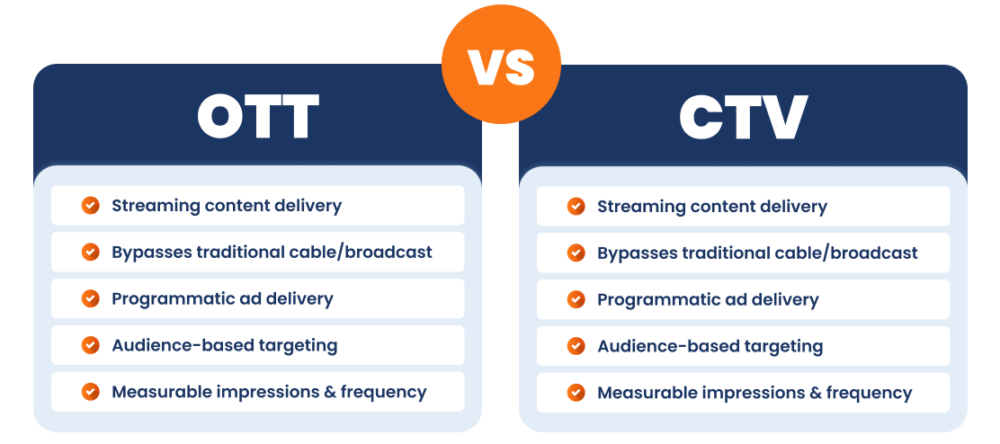
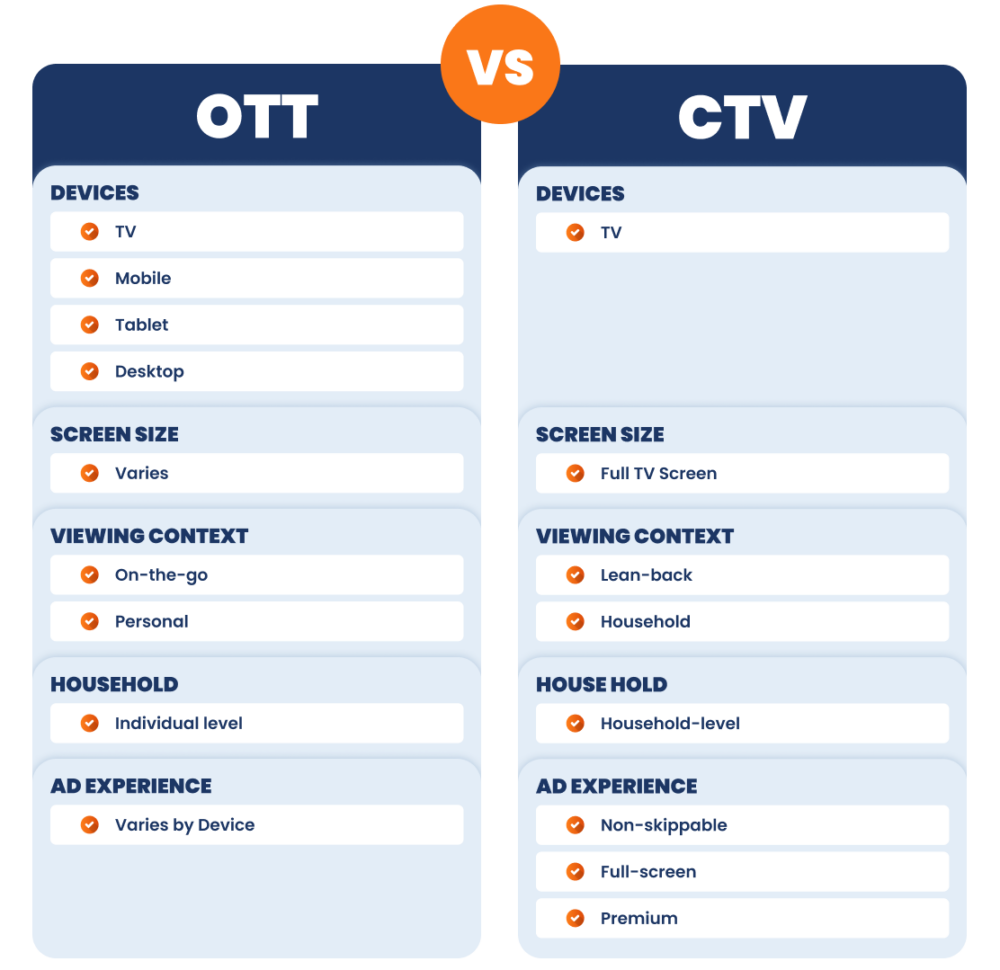
- OTT describes how content is delivered: streamed over the internet, bypassing traditional cable or satellite infrastructure. Any device that streams video content (phone, laptop, tablet, smart TV) is consuming OTT content.
- CTV describes where that content is watched, specifically on a TV screen connected to the internet.
In other words: all CTV is OTT, but not all OTT is CTV.
When someone watches Hulu on their phone during a lunch break, that’s OTT, but not CTV. When they watch the same show on their 65” Roku in the living room that evening, that’s both OTT and CTV.
Where They Overlap
Where They Differ
What This Means for Your Advertising
For home services businesses, CTV is always the preferred buy. Here’s why.
You’re not trying to reach one person on their phone. You’re trying to reach a household. The decision to replace an HVAC system, reroof a house, or remodel a kitchen is a household decision, often made by two people talking on a couch in front of a TV.
CTV puts your brand in that room, on that screen, in that decision-making environment, long before homeowners ever need your services.
How Is CTV Different from Traditional TV Advertising?
Traditional TV advertising hasn’t changed much in 50 years: you buy airtime on a local broadcast or cable channel, and your ad runs during a scheduled window. You pay for impressions based on estimated viewership, and you have almost no control over who actually sees it.
CTV flips that model entirely.
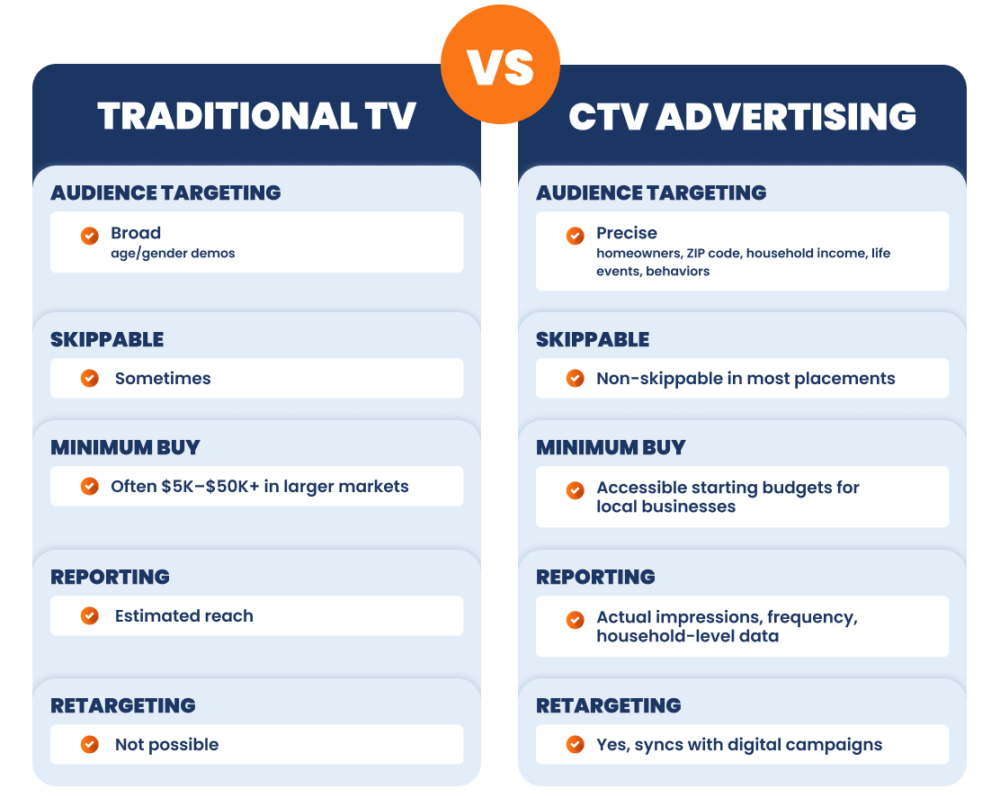
The bottom line: Traditional TV is broadcast. CTV is targeted. And for home services businesses operating in specific zip codes looking for a specific type of homeowner, that targeting precision is everything.
Why CTV Is a Game-Changer for Home Services Companies
Home services marketing has always been local by nature. A roofing company in Scottsdale doesn’t need to reach viewers in Toledo. A plumbing company in Dallas wants to be in front of homeowners in their service area, not renters downtown or commercial properties.
CTV gives you that surgical precision. Here’s why it matters specifically for HVAC, plumbing, electrical, roofing, and garage door companies:
1. You Can Target Actual Homeowners in Your Service Area
Forget reaching “Adults 25–54.” With CTV, you can layer targeting criteria like homeownership status, household income, home value, length of residence, and ZIP code. That means your HVAC ad runs in front of homeowners in the neighborhoods where you actually work.
2. Your Competitors Are Likely Not There Yet
Local home services businesses have been slow to adopt CTV. While they’re competing fiercely on Google Ads and Local Service Ads, the streaming space is relatively uncrowded at the local level. Early movers have a real advantage in building brand awareness before saturation sets in.
3. Streaming Is Where Attention Has Moved
According to Nielsen, streaming now accounts for more TV viewing time than both broadcast and cable combined. Your customers are cutting the cord in massive numbers. If your brand is only showing up on channels fewer people are watching, your awareness campaigns are working against you.
4. Non-Skippable Means Guaranteed Impression
Unlike a YouTube pre-roll that disappears after 5 seconds, CTV ads are typically non-skippable. Your full 15- or 30-second spot runs to completion. That’s a guaranteed impression from a real household, not a click-through bet.
5. It Works With Your Existing Digital Strategy
CTV doesn’t replace your SEO, PPC, or Local Service Ads. It amplifies them. When a homeowner sees your brand on their TV and then searches for an HVAC company the next morning, they recognize your name. That brand familiarity increases click-through rates and conversion rates across every other channel you’re running.
Real-World Examples: What Is (and Isn’t) CTV Inventory
One of the most common points of confusion around CTV advertising is understanding which platforms and networks are actually available as ad inventory and which ones aren’t. The answer might surprise you.
Networks Available on CTV (Where Your Ads Can Run)
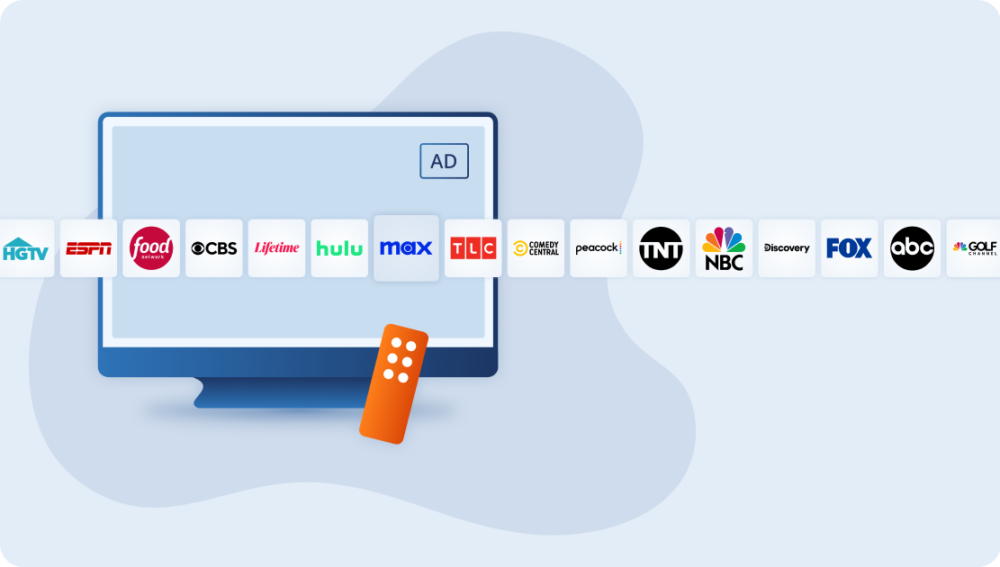
RYNO partners with MNTN, the leading CTV advertising platform in media, which provides access to over 150 premium streaming networks. Here’s a look at some of the most recognizable names in that inventory:
HBO Max: Premium, “Sunday night” television. HBO Max provides advertisers a massive reach to perhaps the most desired demographic in home services, with subscribers skewing on the affluent side.
HGTV: Arguably the single best contextual fit for home services advertising that exists. Homeowners watching renovation content are, by definition, engaged with their homes. Your HVAC or roofing ad in this environment is reaching someone in exactly the right mindset.
ESPN & ESPN2: Massive reach, skewing toward homeowners with disposable income. Sports programming on streaming is one of the fastest-growing CTV environments right now.
CNN & MSNBC: News programming consistently reaches older, established homeowners, the core demographic for high-ticket home services like HVAC replacement and electrical upgrades.
Fox News & Fox Business: Strong reach in suburban and rural markets, which tend to overlap heavily with the service areas of independently-owned home services companies.
Discovery Channel, Food Network & NBC: Broad household reach with content that skews toward homeowners and families, the exact audience making decisions about plumbing, roofing, and HVAC.
These are channels your customers already recognize and trust. When your ad runs in that context, that trust transfers.
What’s NOT Available on CTV (The Platforms That Don’t Sell Ads)
Here’s where a lot of business owners are surprised. The biggest names in streaming are largely unavailable as ad inventory because they either don’t run ads at all, or they don’t sell programmatic inventory to local advertisers.
Netflix: The largest streaming platform in the world introduced an ad-supported tier in 2022, but its inventory is not available to local or regional advertisers through programmatic CTV platforms. Netflix sells ads directly, at scale, to national brands only.
Amazon Prime Video: Amazon’s ad-supported streaming tier sells through Amazon’s own walled-garden ecosystem and is not available through third-party CTV platforms like MNTN.
Apple TV+: Currently ad-free entirely. No programmatic inventory exists.
YouTube / YouTube TV: YouTube runs ads, but it operates through Google’s own ad infrastructure and is not available through independent CTV platforms. It also skews heavily toward desktop and mobile viewing rather than TV-screen CTV inventory.
Why This Matters
Consumers often assume CTV advertising means “running ads on Netflix.” It doesn’t. That’s actually okay. The networks available through programmatic CTV platforms like MNTN reach enormous audiences, in premium environments, with far more targeting precision than any national streaming giant would allow.
The goal was never to get your HVAC company on Netflix.
It’s to put your brand in front of homeowners in your service area, on a TV screen, while they’re watching content they love.
How CTV Targeting Works
One of the most common questions we hear from home services business owners: “How do you actually control who sees my ad?”
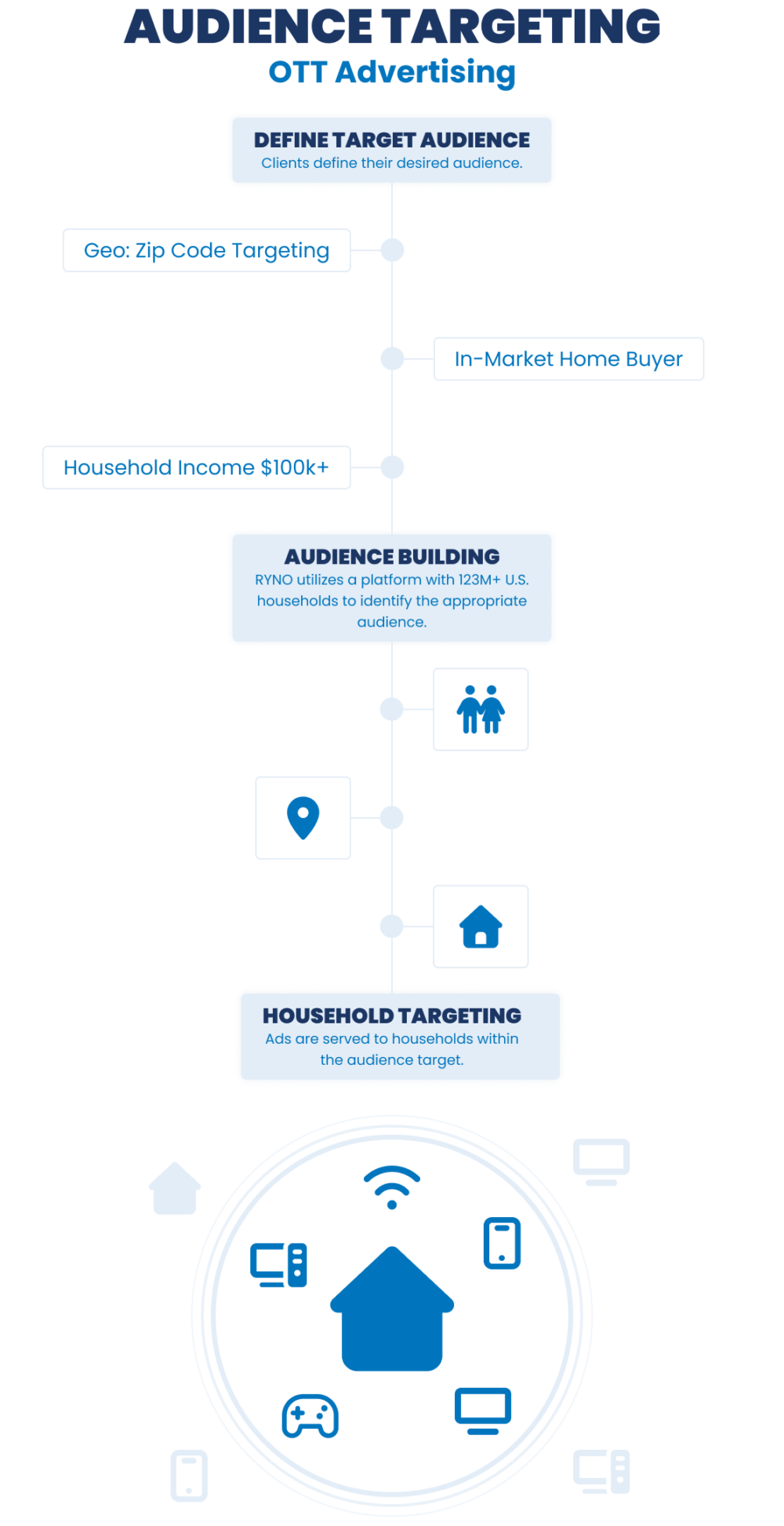
CTV targeting works through audience data layering. Here’s a simplified look at how it comes together:
- Geographic Targeting: Ads are served only within your defined service area, down to the ZIP code level.
- Audience Segmentation: Platforms match your ad against first- and third-party data, including homeownership, household income, recent home purchase, interest in home improvement, prior service searches, and more.
- Device Targeting: You can specify that ads run on CTV devices only (not mobile or desktop), ensuring a premium, full-screen TV experience.
- Frequency Controls: Set caps on how many times the same household sees your ad in a given period, protecting your budget and your brand experience.
- Retargeting Integration: Once a household has seen your CTV ad, that data can be passed back to digital campaigns, creating a coordinated touchpoint sequence across streaming, display, and search.
What Kind of Results Can Home Services Businesses Expect?
CTV advertising is primarily a brand awareness and demand generation tool, not a direct response channel like Google PPC. That’s an important distinction.
You won’t see leads clicking directly from a TV ad. What you will see:
- Increased branded search volume: More people searching your company name directly after repeated ad exposure.
- Higher conversion rates on other channels: Prospects who’ve seen your CTV ad convert at higher rates when they encounter your search or display ads.
- Stronger recall during high-intent moments: When a pipe bursts or an AC goes out, the brand they remember is the one that’s been showing up in their living room.
- Measurable reach and frequency metrics: Unlike traditional TV, you’ll know exactly how many households saw your ad, how many times, and in which zip codes.
The businesses that see the strongest results from CTV treat it as part of an integrated strategy, not a standalone tactic. It plays a critical supporting role in the full customer journey.
Is CTV Right for Your Home Services Business?
CTV isn’t for every business at every stage. Here’s a quick framework to assess fit:
CTV is a strong fit if:
- You have a defined service area and want to build local brand recognition
- You’re already running paid search and want to amplify it with upper-funnel awareness
- You have or are willing to invest in quality video creative (15- or 30-second spots)
- Your monthly marketing budget allows for sustained investment (CTV works best with consistent exposure, not one-off buys)
- You’re in a competitive market and want to differentiate from companies competing solely on search
CTV may not be the right fit right now if:
- You’re brand new and haven’t established your core digital presence yet (your first investment should be your website, SEO, and Google presence)
- You don’t have video assets and aren’t ready to create them
- You’re looking for an immediate lead generation channel rather than brand building
How RYNO Runs CTV Campaigns for Home Services Companies
At RYNO, we’ve built our CTV program specifically for home services businesses. Not as a bolt-on to a general digital marketing offering, but as a purpose-built service grounded in how HVAC, plumbing, roofing, electrical, and garage door companies actually grow.
Our approach includes:
- Service area mapping tailored to your real coverage zones, not just your city
- Homeowner-first audience builds using data layers specific to home services purchase behavior
- Creative guidance to help you develop ads that communicate trust, authority, and urgency in 15–30 seconds
- Full-funnel integration that connects your CTV exposure to your existing paid search, LSA, and SEO campaigns
- Transparent reporting so you see exactly where your impressions are going and what’s happening downstream
Ready to See If CTV Makes Sense for Your Business?
The home services companies that are going to own their local markets over the next five years are the ones building brand equity now, while their competitors are still fighting over the same Google clicks.
CTV is one of the most powerful tools available for doing that work at the local level. And we’re ready to show you exactly how it works for companies like yours.
Video Transcript
Or simply put, it’s TV commercials played on smart TVs, Roku, Amazon Fire Stick, Apple TV. When someone streams TV and any television set that connects to the internet and streams content. When a homeowner sits down to watch their favorite show on their 65 inch smart TV in their living room, your ad appears as part of that experience on the big screen, and not skippable.
Here’s how CTV works. Your commercials run across a network of over 150 premium streaming networks, and when someone streams movies or TV
shows on an ad supporting streaming service like HBO Max, Paramount. Plus, discovery, ESPN, HGTV, Fox News, CNBC. Your ad plays on the channels that your customers already watch and trust every day. The ad itself is a 15 or 30 second video spot that runs before during the shows, your customers watch, and the viewer can’t skip.
That means that every impression is a real impression watched for completion on a full TV screen. CTV versus traditional TV. Now here’s where it gets interesting, especially if you’ve ever run traditional TV ads or looked at the price tag, then walked away. Traditional TV works like this. You buy a time slot on a local channel. Your ad runs to whoever happens to be watching, and at the end you get an estimated reach number.
How many people did you reach but an estimate? You have no control. over who saw it and no ability to follow up. With no real data to act upon. CTV flips that entire model. You control the audience. You control the geography. You get real data like website visits, brand lift, and the number of actual households. And you can retarget the people who saw your ad on other particular channels.
It’s the same TV screen as traditional TV, but with completely different results. Audience targeting. Audience targeting is where CTV really separates itself from anything traditional TV can offer. Traditional or linear TV is a spray and pray approach. You pick a program and time slot, run your commercial, and hope the right people view it. CTV is a sniper. With CTV you can target by age of home, zip code, homeowner status, household income, home value, previous search behaviors, and so much more.
It’s the same TV screen as traditional TV, but with completely different results. Audience targeting. Audience targeting is where CTV really separates itself from anything traditional TV can offer. Traditional or linear TV is a spray and pray approach. You pick a program and time slot, run your commercial, and hope the right people view it. CTV is a sniper. With CTV you can target by age of home, zip code, homeowner status, household income, home value, previous search behaviors, and so much more.
That means your ads only run in front of qualified homeowners in your service area, not renters or not neighboring markets, and not a general stab at your demographic. You can also set frequency caps so the same household doesn’t see your ad too many times, and you can retarget those households with follow up ads across search and display as well.
That kind of precision doesn’t exist on traditional TV and it never has. If you want the full breakdown, including which networks are available, how CTV compares to OTT, and whether it’s the right fit for your business. We put it all in writing. Read the blog below for the full breakdown.
