
 Contact
 8 min read
Generative Engine Optimization (GEO), sometimes referred to as “AI SEO”, has become a bit of a buzzword lately. You might have heard different opinions ranging from “GEO is just SEO with a fancy new name so agencies can sell something” to “SEO is dying and GEO is the replacement.” Do either statements hold any truth?
Both are vast oversimplifications. SEO isn’t dying, and yes, GEO services are a new offering from some digital marketing agencies (although you might see it called a wide range of things, as the industry hasn’t quite settled on a universal term yet – at RYNO, we prefer “GEO”).
Google isn’t suddenly erasing 25+ years of search optimization. In fact, they’ve explicitly said that SEO is relevant to generative search because AI Overviews and AI Mode are rooted in the existing Google Search ranking and quality systems. Your website is still a key piece of the puzzle, and SEO is still the foundation for your online presence. What’s interesting today is that traditional local search doesn’t automatically translate to AI visibility.
Without further ado, let’s dive into the differences between GEO and SEO, and why each plays a different (and sometimes similar!) part in driving your business forward.
The Goals of SEO and GEO
While SEO and GEO do share some overlap that we’ll get into, understanding the goals of each helps to differentiate them.
SEO
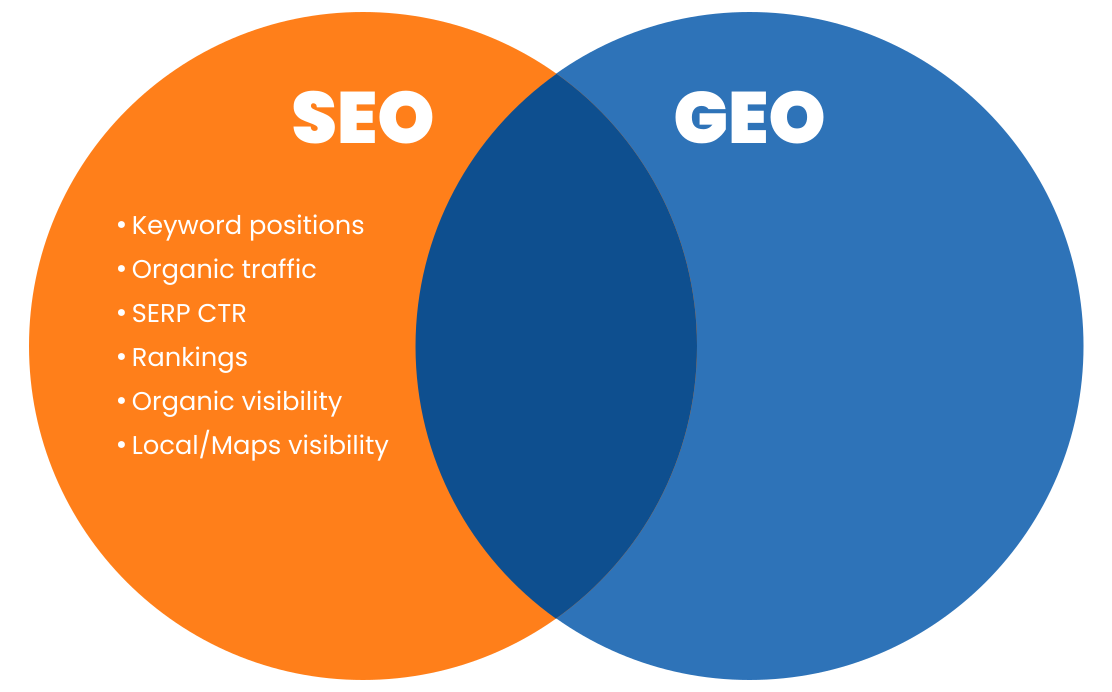
With SEO, you’re optimizing your business’ web presence to improve its visibility in search engines. For contractors, that traditionally means ranking for search terms like “AC repair”, “plumber near me”, or “roof replacement”. With SEO, you’re trying to earn visibility (ranking) for those search terms so that the user sees your website, visits it (the “click”), and finds their way through the funnel to conversion.
GEO
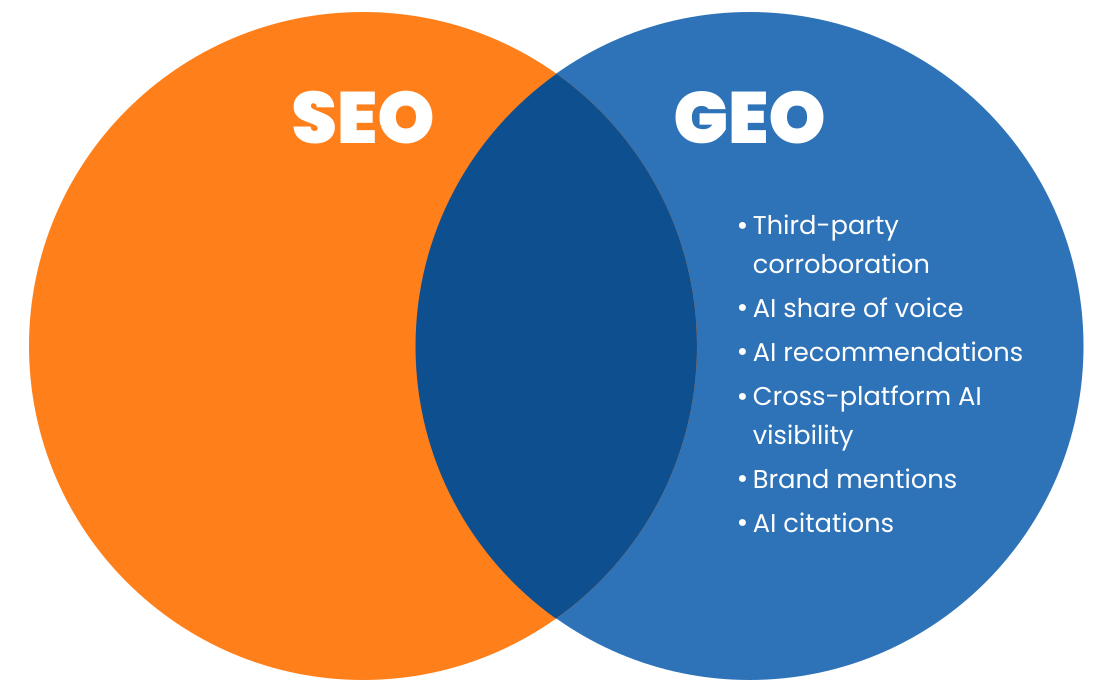
In contrast with SEO’s journey of visibility→search→click→conversion, GEO looks like question→AI synthesis→brand mention/recommendation/citation→potential click→conversion. However, the potential click→conversion piece isn’t really the direct goal of GEO like it is with SEO.
With GEO, you’re optimizing the information and signals surrounding your business so that generative AI systems can better understand, retrieve, cite, and potentially recommend your brand when answering relevant questions.
Where SEO and GEO Overlap
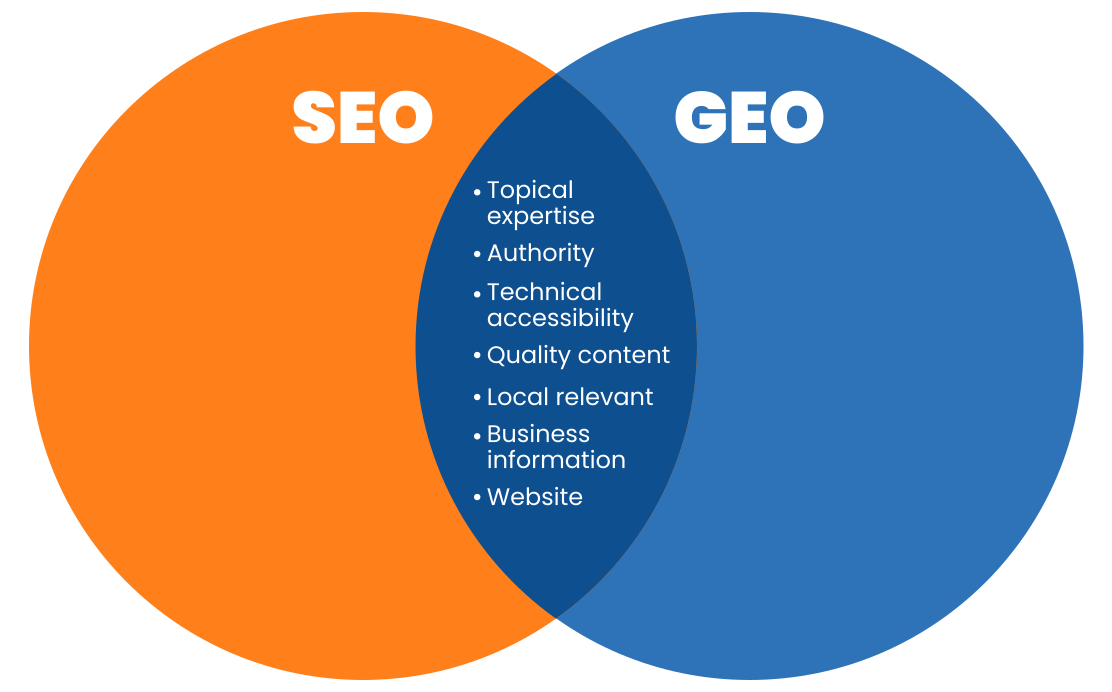
GEO isn’t some magic bag of tricks. In fact, SEO and GEO do share much of the same foundation. Google’s own documentation says there are no additional technical requirements needed to appear as a supporting link in AI Overviews or AI mode. A page only has to be indexed and eligible to appear in Google Search with a snippet. And that’s exactly the foundation of SEO: getting your pages visible in search engines.
The same principles guiding good SEO apply to GEO:
- Crawlability and Indexability: AI can’t retrieve content it can’t access
- Helpful, Authoritative Content: Both traditional and AI search engines want to provide their users with the most helpful, reliable answers possible
- Clear Site Architecture and Internal Linking: Pages and relationships between topics should be easily understandable
- Local Relevance: Especially for home services businesses, your location and service information is essential for both SEO and GEO
- Authority and Trust: Both traditional and generative search systems need signals that verify information as being credible
- Accurate Business Information: This is more than just NAP. Who you are, what you do, and where you do it should be consistent and accurate everywhere it appears.
What’s Important for Contractors to Understand about SEO and GEO Today?
There’s a lot of information to parse, but there are certain things that contractors can learn to better understand how SEO and GEO are different levers to pull, and when to pull them. Sometimes that’s separately, and sometimes it’s together.
Your Website Still Matters
Let’s clear something up: your website is still essential, and it doesn’t matter if the conversation is about SEO or GEO.
It’s fair to ask, “If AI is answering questions, do websites even matter anymore?” The answer is a resounding yes, and BrightLocal’s 2026 research confirms this. They analyzed over 200,000 local searches across ChatGPT, Google AI Mode, and Google AI Overviews along with about 1.9 million AI citations. Among the 116,000 unique domains used as sources, 93% were business websites. Not only that, business websites accounted for over 40% of all the citations analyzed.
AI search hasn’t made your website less important. In fact, it’s created another audience for the information on your website, making three: homeowners, traditional search engines, and AI systems.
With so many eyes (some literal and some not) on your website, it’s a very important place to provide key pieces of information: who you are, what you offer, where you offer it, and why you’re credible. It’s one source of truth, but one with multiple discovery environments.
Ranking Isn’t the Same as Being Recommended
In the same study, BrightLocal tracked local businesses across Google Maps and three AI systems to see how often they showed up. Here’s what they found:
- Google Maps: 66% of searches
- AI Overview: 38% of searches
- ChatGPT: 33% of searches
- Google AI Mode: 32% of searches
What that tells us is that being visible in Google’s traditional local ecosystem is important, but it doesn’t guarantee AI visibility. An Ahfrefs study looking at traditional search results and AI citations presented similar findings. There was surprisingly low URL overlap between traditional search and the sources that AI cited.
Starting to see where this is going? We can see that SEO helps get your information into the candidate pool, but GEO is targeting something different: what makes an AI system actually select, cite, or recommend you from that pool.
Organic Search Rankings vs. Synthesizing
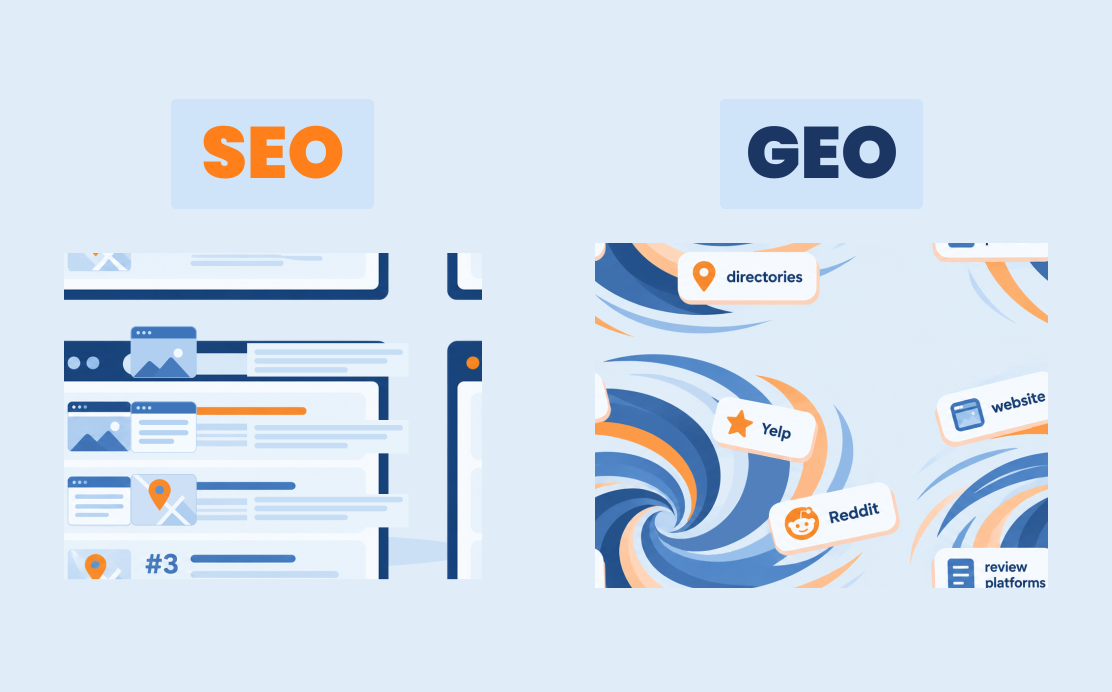
The traditional SEO wisdom has conditioned us to think in terms of rankings. #1 is best, #2 is great, and so on. SERPs are a bit more complicated than that now, but it’s still generally the case. However, generative AI doesn’t work that way.
Instead, these AI systems pull information from multiple sources and synthesize an answer. Google tells us that AI Overviews provide information drawn from a range of sources, and its newer AI experiences allow users to ask more complicated questions and follow-ups. This creates a new measurement problem. You can’t just say “We’re #1 on ChatGPT”.
Adding to the complexity, AI answers aren’t always the same. A few users could ask the same question and get different results. AI answers are probabilistic, which means brands can appear and disappear between responses to the same question.
GEO Visibility Is Less Predictable Than SEO Rankings
In the same 2026 BrightLocal study referenced earlier, they also repeated identical local prompts over time. What they discovered is that there is meaningful variation in which businesses appear in AI results, as well as differences between AI platforms.
Google AI Mode and Google AI Overviews only shared about 29% of businesses. ChatGPT overlapped with Google AI Overviews and Google AI Mode only around 20%. This helps us understand GEO even further. You can rank well on Google Maps, appear in Google AI Overview, and still not appear in ChatGPT. And even that can change day-to-day, or with slight variations in how the questions are asked.
Research from Semrush reinforces the idea that AI systems behave differently. In a study tracking nearly 4,000 domain appearances across 115 prompts, 14 countries, and 4 different AI engines, it found significant differences in how AI systems cite sources versus mention brands. ChatGPT produced a citation in 87% of tracked domain appearances, and had a 20.7% brand mention rate. Gemini was almost the complete reverse, showing a 21.4% citation rate and an 83.7% brand mention rate.
What does all this mean? Well, SEO for home services contractors is more or less asking the question “Where does my business rank?” With GEO, we’re asking “How often does my business appear?” and “What is AI saying about my business?” GEO is aiming more at your share of the voice, which means looking at metrics like citation frequency instead of a single ranking position.
GEO Expands Optimization Beyond Your Own Website
SEO has never just been relegated to your own website. Links, reviews, citations, your GBP, and other off-site signals have always matter. However, GEO really pushes the importance of the “information ecosystem” around your brand further.
AI systems can learn about your business or pull information about a contractor from multiple sources, including:
- Your website
- Google Business Profile
- Review platforms
- Local directories
- News sources
- YouTube
- Reddit/forums
- Third-party lists
- Industry websites
Again, SEO is looking more towards rankings. GEO is looking more at mentions. Ahrefs looked at 75,000 brands and found that branded web mentions have one of the strongest correlations with ChatGPT visibility. A 2025 Ahrefs AI marketing study presented similar findings, with the strongest correlating factors for AI Overview brand visibility including branded web mentions, branded anchor text, and branded search volume.
While there’s a conversation about correlation vs. causation to be had here, we can take away something important from these findings. Your website tells AI what you say about your business, while the rest of the web tells AI what everyone else says about your business. For contractors in home services industries, this makes things like reviews, third-party mentions, and consistent brand information increasingly important.
GEO Changes What a “Conversion” Can Look Like
When comparing GEO and SEO, there’s a definite wrinkle, at least for now, in how to track and measure what “success” looks like. With SEO, it’s been more or less established that rankings, impressions, clicks, sessions, and conversions can and should be tracked, attributed, and measured.
With GEO, it’s different. A homeowner today might ask ChatGPT “Who is the best electrician in San Diego for a panel replacement?” ChatGPT then recommends a contractor, and the homeowner remembers the name. Later, they Google the same question. They see your name among the results, click, and call. Your AI visibility helped get that conversion, but the attribution will likely be credited solely to traditional search, often making it difficult to accurately measure the impact of your GEO efforts.
There’s plenty of data to support just how frequently AI visibility happens without a click. Pew Research tracked the Google behavior of 900 U.S. adults and found that when an AI summary appeared, users clicked traditional search results on only 8% of visits. Without an AI summary, that number dropped to 15%. And as for sources cited directly within an AI summary, only 1% of the time.
For GEO, that means tracking and measuring is a bit more complicated, and we need to be looking at more than just referral sessions, including:
- Brand mentions
- Citation frequency
- Recommendation frequency
- Branded search growth
- AI referral traffic
- Conversions
Fewer Clicks Doesn’t Mean Lower Value
Semrush analyzed billions of visits across over 50,000 websites and 17 different industries and found that AI traffic grew 66% in 2025. That still only represented less than 0.15% of total visits. Traditional organic search remains vastly larger than AI referral traffic. This is evidence in spades that SEO still matters.
Interestingly, Semrush also reported that the average visitor arriving through AI search was 4.4x as valuable than the average organic search visitor, based on conversion rate. This isn’t a home-services specific dataset, but it definitely points us towards a certain hypothesis.
Someone who actually does click after having an AI system research, compare, and synthesize information for them might be a lot further along in their decision-making process. That means GEO doesn’t necessarily need to replace SEO traffic volume to be significant.
It’s Not About GEO vs. SEO. It’s About Visibility.
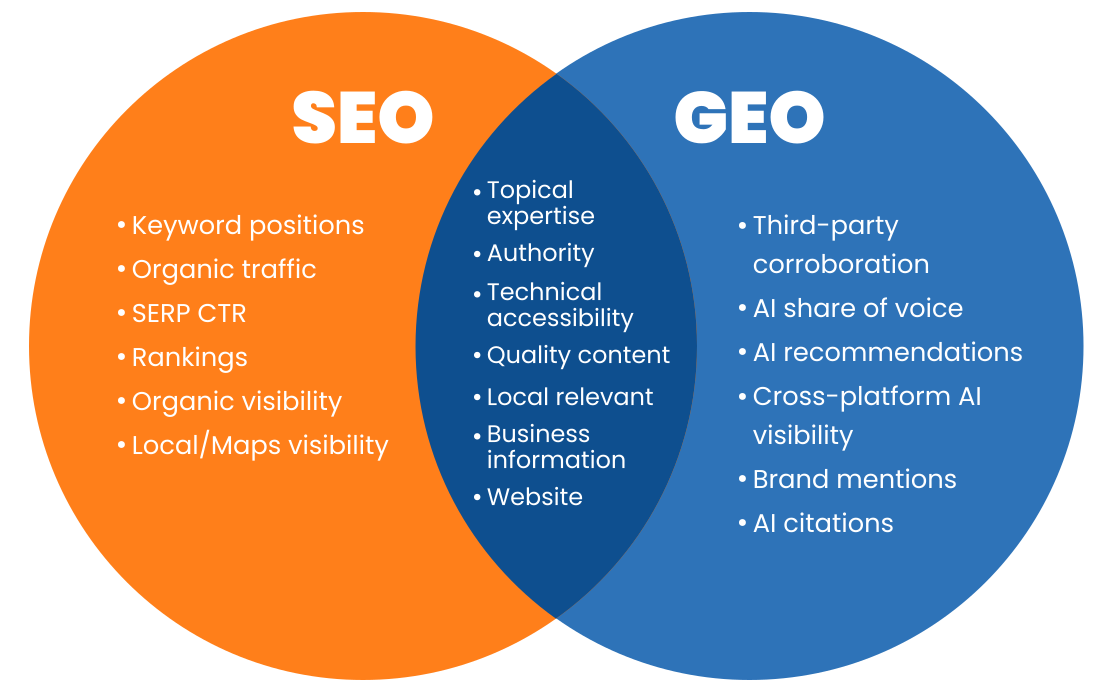
What all HVAC contractors and home services businesses want from their digital marketing is more leads that turn into higher revenue. So it’s worth making the connection now that SEO and GEO might have different goals, but they work together towards the same end.
SEO is the foundation that helps search engines find, understand, and trust your business. GEO expands on that work to the environments where AI systems like ChatGPT and Gemini are deciding which business and information to synthesize, cite, and recommend. These aren’t competing strategies, they simply overlap.
Remember, homeowners don’t care if they found their plumber or roofer through Google Maps, Gemini, an AI overview, or ChatGPT. They just care about finding someone they can trust. The current digital search landscape is increasingly mixing all of these together.
If you’re asking yourself, “Should I invest in SEO or GEO?”, you’re asking the wrong question. What you should be asking now is, “Can homeowners find and trust my brand everywhere they’re searching?”
