
 Contact
 4 min read

A growing battle between Google and companies that scrape its search results is raising serious concerns about the reliability of SEO ranking data. As Google cracks down on automated data collection, major SEO providers are accusing the search giant of deliberately serving misleading results that make websites appear to rank differently than they actually do. These manipulated results, known as “poisoned SERPs,” could have significant implications for SEO reporting.
How widespread is the issue? In an analysis spanning 29.9 million Google search results pages, SEO data provider Nozzle found signs of poisoning in 22.6% of the qualifying desktop results it evaluated across the first two pages. Even more concerning for contractors, 15% of the U.S. home services search results examined showed signs of poisoning.
For home service businesses investing in SEO, these findings raise important questions about the accuracy of ranking reports. A sudden drop in rankings could reflect a data collection problem rather than an actual decline in search visibility. At RYNO, we’re closely monitoring these developments to distinguish genuine performance changes from misleading reporting data.
What Is the “Battle” Between Google and Scrapers About?
Scraping means using software to collect information from webpages automatically. For our discussion, that information comes from Google’s search engine results pages (SERPs).
Rank trackers collect results for particular keywords, locations, and devices to record where websites appear. Some platforms manage collection themselves, while others use outside data providers. Companies such as SerpApi sell structured search data through software connections called APIs, handling the collection work for other applications.
Google has never officially given unrestricted scraping its blessing. Their spam policies prohibit automated queries without permission, explicitly including scraping for rank checking. Historically, enforcement has been relatively lax, at least until recently.
What’s changing now is the difficulty of collecting results reliably. Rank-tracking companies and search data services report more blocked requests and additional steps to retrieve usable information. More concerning, several say they sometimes receive pages that look like ordinary search results but contain different organic listings. AccuRanker describes these as “poisoned SERPs.” A tool can mistake the returned page for valid ranking data, potentially turning a collection problem into what looks like a performance decline. Even some of the SEO industry’s largest data providers, including Semrush, are accusing Google of poisoning search results and reporting that these practices are negatively affecting the accuracy and reliability of their ranking data.
The dispute also extends beyond technical defenses. In December 2025, Google announced a lawsuit against SerpApi, alleging that it circumvented protections and resold copyrighted content appearing in search results. The lawsuit reinforces Google’s position against unauthorized scraping and redistribution of search content, highlighting the growing legal and technical challenges facing third-party SEO data providers.
A Timeline of Google’s Scraping Crackdown
The current disruption developed through a series of changes, rather than a single switch being flipped.
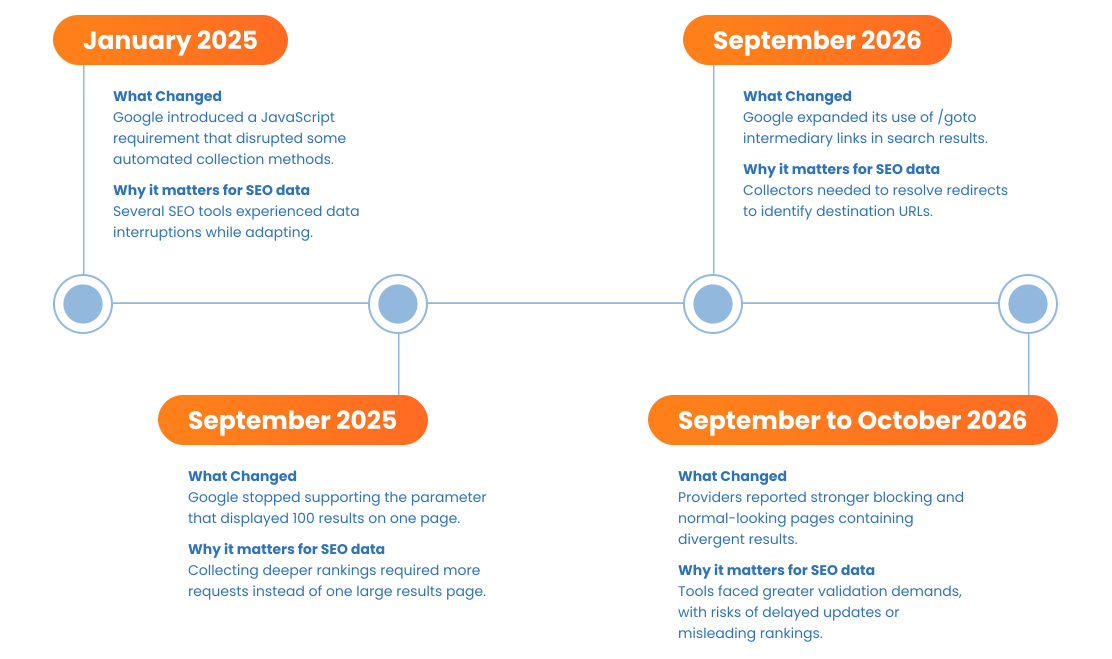
Google has been making search results harder for SEO tools to collect for a while. More recently, SISTRIX has reported receiving results that differ from what regular searchers see, adding another wrinkle to an already frustrating situation. Google hasn’t confirmed that it’s deliberately serving those different results to scrapers, but the reports give SEOs another reason to look closely at an unexpected ranking drop before assuming potential customers are having a harder time finding the website.
Industry Takes on the Disruption
The industry broadly acknowledges the collection challenge, but explanations and reported impacts vary.
SISTRIX sees AI competition as a likely driver. In its explanation of the changes, CEO Johannes Beus argues that Google is trying to restrict emerging AI competitors’ access to its index and prevent AI training uses, with SEO tools caught in the middle.
AccuRanker highlights the difficulty of detecting misleading results. Their analysis of poisoned SERPs describes pages that retain familiar search features while displaying different organic listings. They’ve reported successive changes to their collection and validation methods as the problem evolves. The concern extends beyond whether data can be collected to whether the data being collected is accurate and trustworthy.
Semrush recommends checking unexpected changes against your own data. In its October 27 update, the company says it filters invalid results, flags questionable data, and collects replacements. It advises users to compare unusual ranking changes with Google Search Console. Semrush also identifies AI collection as a suspected driver, while noting that Google hasn’t publicly confirmed that explanation.
These accounts show an industry adapting to more difficult conditions. It’s also worth noting that some of the claims going around that “rank tracking is finished’ are a bit premature. If you’re an SEO using a rank tracker, what you should be looking at moving forward is how results are validated, how recently data was collected, and whether additional evidence supports a reported change.
The RYNO Take on Measuring SEO Performance
At RYNO, we are big believers in starting with Google Search Console (GSC) data to evaluate organic search performance. Its performance reporting provides clicks, impressions, click-through rate, and average position directly from Google, without depending on a third party scraping search results.
Of course, GSC has its limits, too. An average position won’t tell you where you rank for every search, and Google leaves out some search terms for privacy and other reasons. There’s still plenty of value in third-party tools, especially when you want to see how competitors are showing up.
Our perspective is straightforward: an unexpected ranking report should prompt investigation before it prompts a strategy change. Compare the affected queries and pages with Search Console trends, examine website traffic and conversions, and check the data provider’s collection dates and service updates. A discrepancy is a reason to investigate both performance and measurement.
This is a story we’ll keep following at RYNO, because the way we measure SEO is changing along with search itself. Rankings still matter, but they’ve always been part of a bigger picture. Our focus is on what matters most: helping the right people find your business, connect with your services, and become customers. That’s ultimately how we measure meaningful SEO performance and demonstrate the value of our work.
