
 Contact
 10 min read
2027 will be here in short order, and as home services businesses reevaluate their marketing strategies heading into the new year, one thing is clear to us at RYNO: what worked before isn’t going to work forever.
The digital marketing strategy for a lot of agencies and companies has been a simple formula for a while. Have a solid website, invest in SEO, run Google Ads campaigns, get reviews, and the leads come rolling in. This foundation does still matter very much, but the environment around these fundamentals has changed quite a bit.
From more discovery channels and AI-generated answers to increasingly sophisticated competitors, new advertising platforms, and a homeowner journey that spans multiple channels and touchpoints, digital marketing in the home services industry is evolving rapidly.
Home Services Marketing Has Become More Competitive
Before we look at how digital marketing is changing, it’s important to note just how much the home services industry has evolved, too. Long gone are the days of just a few mom n’ pop shops and “Chuck in a truck” operations dominating metropolitan areas. The last several years have seen a great deal of consolidation and private equity involvement, which has a lot of ramifications on your ability to lock down a market.
First, there are more large, multi-location operators than ever before. We are seeing a level of sophistication from operators and organizations that was unimaginable in the 90s, or even just a decade ago. The influx of technology integrations has allowed early adopters to see a major rise in efficiency in all kinds of aspects of the business from scheduling and dispatching to training and feedback. In order to stay competitive, the bar has risen significantly.
This isn’t to say that contractors are competing for a shrinking pie, of course. According to a ServiceTitan survey of more than 1,000 residential contractors across HVAC, electrical, plumbing, roofing and other trades, 63% described themselves as thriving or experiencing consistent growth. What is true, however, is that you’re now competing against increasingly sophisticated organizations for the same homeowner.
The Homeowner’s Search Journey Doesn’t Happen in One Place Anymore
Here’s one of the most important things to understand about digital marketing today. The user journey isn’t straightforward anymore. The number of channels and entry points to the top of the funnel has increased significantly. According to a recent BrightLocal study, 75% of consumers used more than one channel during their most recent search for a local business.
Google is still used in 71% of those customer journeys, with 52% starting there, but it’s clear that it’s not the only way users are making decisions about what local businesses to pick. AI platforms, social media, and review sites are now often part of the research stage before making a choice.
It’s easy to say “lead volume is down” and blame it all on AI. In fact, even Angi reported a 13% YoY decline in U.S.-based home services leads in 2026. However, it’s not that people aren’t searching for businesses online anymore. In the same BrightLocal study, they found that 84% of people had also searched for a local business online within the last three months. It’s that the journey has changed. Now, contractors and their marketing partners need to understand that their approach has to evolve toward a more connected, multichannel approach, with an increasing emphasis on omnichannel strategy.
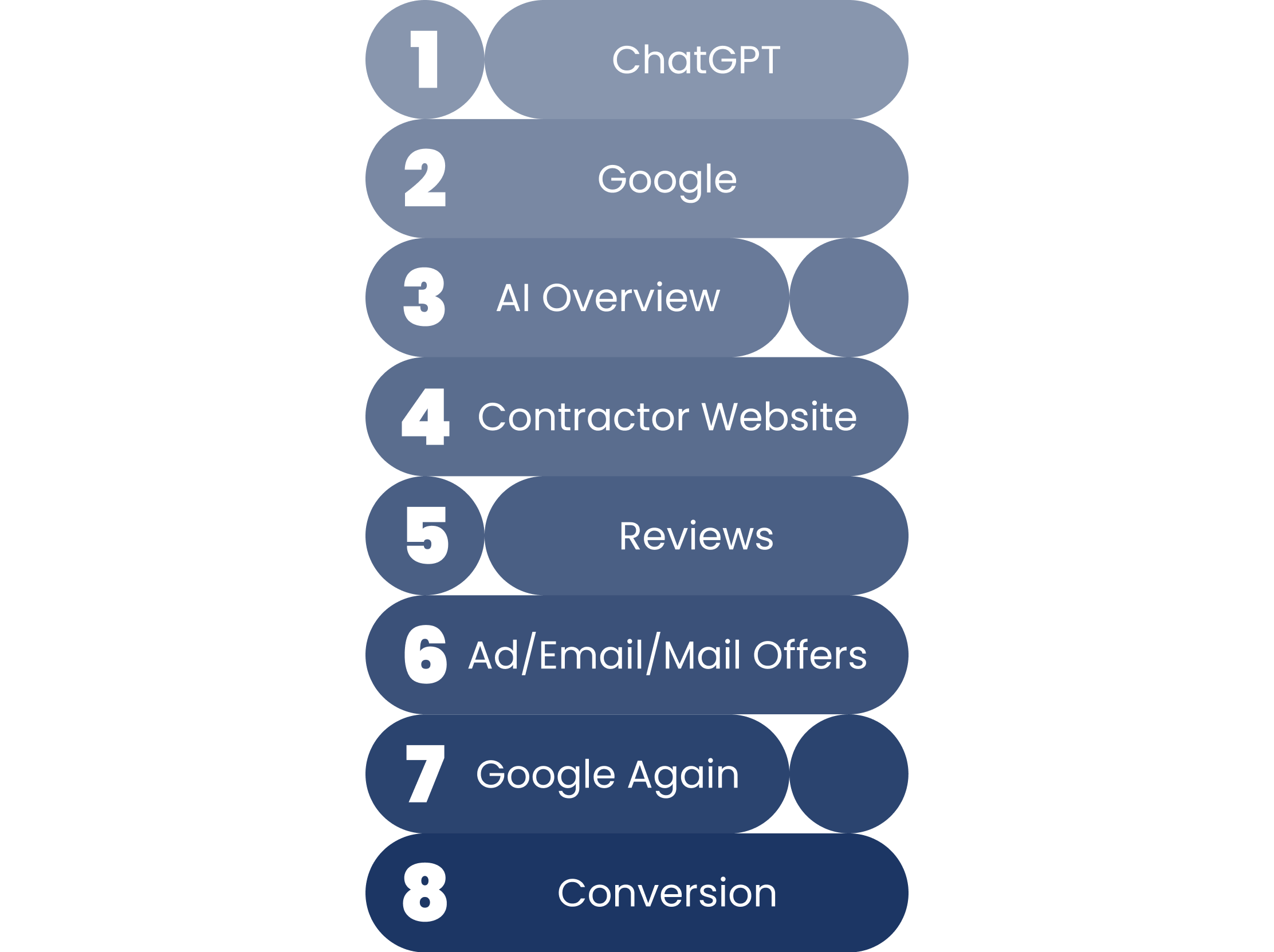
Today, a hypothetical journey might look like Sarah, a 41-year-old homeowner, needing her AC replaced. She first turns to ChatGPT to ask why her system is no longer turning on, initially looking for help troubleshooting the issue. After learning that replacement may be necessary for her 20-year old system, she asks how much a new AC system might cost before turning to Google to search “best AC replacement near me.”
Sarah reviews the local map pack, looking at ratings, reviews, and nearby contractors, then turns to Google’s AI Overview for more detail on her options. A few companies catch her eye, so she clicks through to their websites to learn more and compare them side by side. She also asks ChatGPT about some of the companies she is considering.
Sarah remembers receiving a mailer with a special from Sammy’s Heating & Cooling, and the company keeps showing up throughout her research. They have strong Google reviews, a few positive mentions in a Reddit thread, and are recommended in both Google and ChatGPT. After seeing the company across several different touchpoints, she ultimately decides to go with Sammy’s Heating & Cooling.
AI Is Changing What It Means to Be “Visible” Online
AI hasn’t just been exploding in popularity, it’s becoming a local discovery engine. In a March 2026 study by BrightLocal, they found that 45% of consumers had used AI tools for local-business recommendations during the previous year, compared with 6% in their previous survey.
Additionally, we can see that 23% of those same participants used AI during their most recent search, and 31% use AI for local recommendations monthly. That’s a really big change in a year’s time, and for contractors, it’s yet another sign that multichannel and omnichannel strategies are increasingly vital, rather than solely relying on Google for leads.
SEO Still Matters in an AI Search Landscape, But It’s Changing
The rise of AI search doesn’t mean the fundamentals of SEO suddenly stopped mattering. If anything, there’s growing evidence that many of the same signals that help search engines understand your business also help AI platforms decide when and where to surface it. The difference is that the relationship between optimization and visibility isn’t quite as straightforward as it once was.
A September BrightLocal study helps illustrate that complexity. After analyzing more than 200,000 localized searches across ChatGPT, Google AI Mode, and Google AI Overviews, researchers found some relationship between traditional local visibility and AI visibility, but far from a one-to-one correlation. Google Maps mentioned the tracked business in 66% of searches, compared to 32% to 38% across the three AI platforms.
AI recommendations are also much less consistent than a traditional search ranking. When BrightLocal repeated the exact same prompts, there was only 21% to 33% overlap between the businesses recommended from one response to the next. Different AI platforms agreed even less. A business could surface in one response, disappear in the next, or be recommended by one AI platform but not another.
That doesn’t make optimization less important. It changes what optimization looks like. Instead of trying to earn a predictable position on a results page, Generative Engine Optimization (GEO) is about strengthening the signals that give your brand more opportunities to be understood, cited, and recommended across a much less predictable search environment.
And many of those signals start with the same foundation as SEO. In BrightLocal’s study, 93% of the unique domains AI platforms used as sources were business websites, and business websites accounted for 42% of all citations. Your website, content, local relevance, authority, and overall search presence still matter. SEO and GEO simply work together toward a broader goal now: making your business as visible and understandable as possible wherever homeowners are searching.
Winning the Search Doesn’t Always Mean Winning the Click
Pew Research tracked the Google search behavior of 900 U.S. adults and found that, when an AI summary appeared, users clicked on a traditional search result only 8% of the time. Without an AI summary, those same users clicked one on 15% of visits.
Going even further, users only clicked on the source cited within the AI summary itself on 1% of visits. Browsing sessions ended after 26% of searches containing an AI summary versus 16% without one. There’s a significant number of users that seemingly get an answer, but then take their next step elsewhere.
The takeaway here for contractors is that even if you’re seeing a decline in clicks, that doesn’t mean your efforts are in vain. We know that the user journey has changed. We know that users are doing their research across a number of platforms. What matters even more now is visibility across all the places the users are searching.
Paid Advertising Is Expanding Beyond Traditional Search
AI isn’t just changing how users discover your business organically, either. It’s becoming its own advertising channel, just as we predicted in 2025. In May 2026, OpenAI rolled out their beta self-service Ads Manager, CPC bidding, and expanded conversion measurement. OpenAI specifically describes ChatGPT conversations as frequently being decision-oriented, involving people learning, comparing and deciding what to do next.
Google Ads isn’t less important, to be clear. But this is continued evidence that there are simply more places where your business can and should be visible. Google Ads is better for capturing explicit demand, like “AC repair near me”. ChatGPT is going to make more sense for what we refer to as conversational advertising, like the query “should I repair or replace my 20 year-old air conditioner?”
Further evidence of the increase in conversational advertising within ChatGPT happened quite recently, in fact. On September 16th, OpenAI announced testing of Sponsored Agents, new AI-powered ad-creation capabilities and integrations with HubSpot and Shopify. Sponsored Agents allow someone to click an ad and then have a clearly labeled conversation with the advertiser’s agent. While it may seem like this change is just targeting ecommerce, you can see the consumer experience they are developing and why engaging with your target audience in new ways will be critical to the future of marketing..
The New Playbook Can’t Rely on Waiting for Homeowners to Search
In years past, it was often enough to simply rank on Google. Now, visibility across multiple channels is incredibly important. According to a 2025 study by Modernize, which includes feedback from over 150,000 homeowners, nearly 7 in 10 homeowners research contractors online, and reviews, references, and local reputation significantly contribute to their decision.
There’s a lot of opportunity that exists before the homeowner makes the final decision on which contractor to pick. Another Modernize study shows that 53% of homeowners spend 1-5 hours researching before ever beginning a project. Combined with our understanding of how consumer behavior has shifted, this means visibility and repeated brand messaging in a wide variety of channels is more important than ever.
Reach the Right Homeowners Before They’re Actively Looking
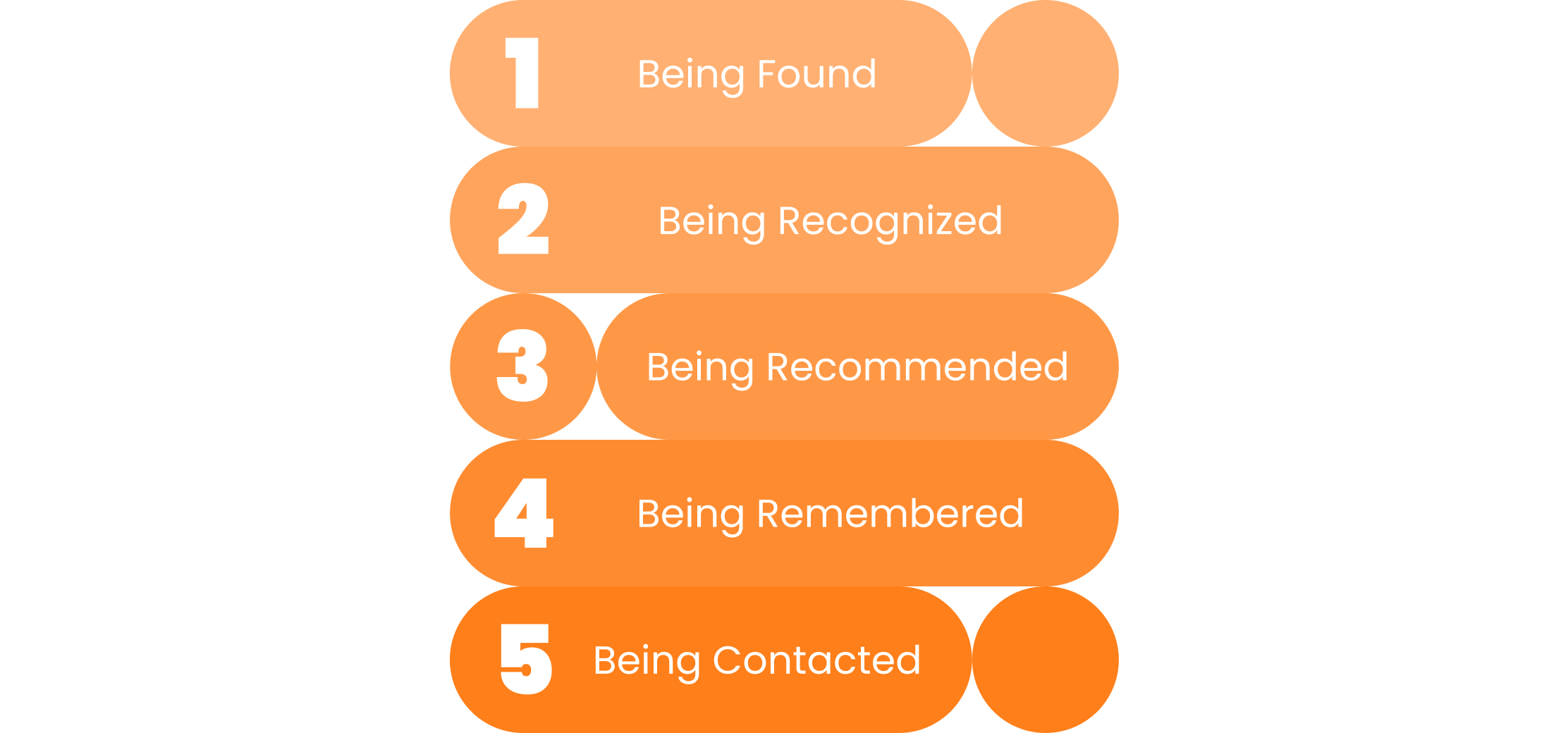
Search engines and AI aren’t the only places that you want your brand to stand out. Your messaging can also reach homeowners through channels like CTV, email, and direct mail.
Search captures demand, but coordinated, targeted outreach builds awareness before that demand ever becomes a search.
From advertising your company during football season to targeted direct mailers and emails, getting your brand noticed and trusted before the research starts is how you turn visibility into revenue.
More Channels Aren’t the Only Answer. Connected Channels Are.
Of course, simply adding more channels to your marketing mix isn’t the point. If your SEO, PPC, GEO, email, direct mail, CTV, and other campaigns are all operating independently, you may have expanded your reach, but you haven’t necessarily built a better marketing strategy. The real opportunity is getting those channels to work together.
Imagine an HVAC company looking to drive more system replacements in a specific part of its service area. Instead of launching a standalone campaign on one platform, it could identify the right households and build a coordinated campaign around that same audience.
Those homeowners might receive a targeted mailer introducing the company and its replacement offer, followed by an email reinforcing the same message. If they start researching replacement options, the company can already be visible through their SEO and GEO strategy. When they turn to Google ready to find a contractor, paid search provides another opportunity to be there. If they ask ChatGPT whether it makes sense to repair or replace their aging system, there’s now an advertising opportunity there, too. Now, the homeowner has seen the brand multiple times and is already familiar with their messaging, versus some companies they’ve never heard of. Who do you think they’ll choose?
Those don’t have to be several separate campaigns. They can be one campaign expressed across multiple touchpoints and can be especially effective when combined with a compelling offer.
This distinction is what makes omnichannel marketing so important to the new home services playbook. The homeowner journey outlined earlier isn’t linear. Someone might discover your brand in one place, research it somewhere else, encounter it again days later, and finally convert through an entirely different channel. Your marketing strategy should be built around that reality.
The goal isn’t to be everywhere just for the sake of being everywhere. It’s to make each interaction reinforce the last one, so no matter where a homeowner is in their decision-making process, they encounter a consistent company, message, and reason to choose you.
Search captures demand. GEO expands where you’re discoverable. Paid media puts you in front of homeowners at moments of intent. Email, direct mail, and CTV create and reinforce awareness. When those efforts are coordinated, each channel can make the others more effective.
This is the evolution of the playbook: not replacing what worked before, but connecting it with the new ways homeowners discover, research, remember, and ultimately choose a contractor.
The Home Services Marketing Playbook for 2027
The new playbook isn’t just about a multichannel approach, it’s coordinating those efforts together into a cohesive omnichannel campaign.
Here are the 5 keys to winning 2027:
- Don’t abandon search. Expand your definition of search.
- Don’t confuse more channels with omnichannel marketing. The key is how those channels are coordinated.
- Don’t optimize every channel in isolation. Create a consistent experience as homeowners move from one touchpoint to the next.
- Don’t leave visibility on the table. Add and/or improve your existing channels to increase the number of touchpoints for potential customers.
- Don’t rely exclusively on capturing existing demand. Focus on capturing future demand, too.
As you’re building your 2027 marketing plan, evaluate whether your marketing partner’s playbook has evolved alongside your customer’s behavior.
RYNO’s Playbook Is Evolving, Too
At RYNO, we’ve been committed to serving the home services industry with elite, transparent marketing services for nearly two decades. That commitment comes with the dedication to stay ahead of the game. To that end, we’ve expanded our offerings and refocused our existing efforts to ensure contractors who partner with us have a winning strategy designed to drive revenue.
From adding GEO services and ChatGPT Ad management as well as targeted email and direct mail marketing, we’ve updated our capabilities to enable your brand to shine wherever your customers are looking.
Our full suite of services is an ecosystem that works together instead of operating as separate pieces of your marketing strategy. As business owners and marketing leaders head into Q4 and start planning their 2027 marketing strategy, it’s worth asking a simple question: Is your marketing strategy built for where homeowners used to search, or for how they’re making decisions now?
